

Tuber Storage
Winter storage is one of the trickier and more intimidating parts of growing dahlias. Nearly every dahlia grower has their own preferred method for storing their tubers while dormant. They vary from packing in a medium and putting inside, to leaving outside under some protective trees or eaves.
There are a lot of different ways to be successful in storing your tubers.
You will likely need to experiment to find what works for you.
Note: tubers that are healthy going into storage are less likely to have issues in storage and be more forgiving of conditions. This is where good care through the season, and digging when right, really play a part. To demonstrate I’ve attached some photos of my tubers that have been in my shed, uncovered, since last June. They were roughly washed, kind of divided, and then left alone. You can see that while they aren’t pretty, they have survived from June to May from a cold and damp shed through a hot and dry summer. So when we talk temperature and humidity it is important, especially when dealing with temperamental cultivars, but it is one piece of the puzzle.


Also always remember: some cultivars simply don’t like storage and aren’t as robust as others. Ask around before purchasing a cultivar - there’s usually a few stories about the bad & diva ones!
Most Common & Basic Advice
Lift once appropriate at end of season → remove excess soil or even wash → cure/dry briefly
Store in medium (vermiculite/coir/etc.)
Keep at ~4–10 °C in dark location
Maintain moderate humidity (not dry, not wet)
Check regularly and remove rot or problem solve
The Goldilocks Goal of Storage: a stable equilibrium
Cool enough to suppress metabolism/keep dormant but not so cold they freeze and turn to mush
Moist enough to prevent dehydration
Dry/aerated enough to prevent pathogens/mould/fungus from growing
If you have to choose: typically slightly too dry is better than slightly too wet. Tubers can lose quite a bit of moisture before they become unusable. A rotten tuber is harder to fix and risks spread to other tubers. So if you add moisture or humidity do so gradually and monitor.
Note: some regions are harder than others because of this. Compare QLD (higher temperatures, higher humidity) to Victoria (lower temperatures, typically damp) so storage & digging strategy need to account for this. I can dig from Mid-May in Gippsland, Vic, and replant in November, where my friend Bec McConnell in Qld avoids long storage by digging and dividing closer to planting time in August/September.
The Breakdown
Temperature & Humidity
Tubers need to be kept below 16c (4-10c is ideal) with 60-70% humidity and in the dark (like potatoes).
Too warm and dry = sprouting and/or shrivelling
Too cold and wet = rot or freezing damage
The reason there is a lot of different advice on how to store tubers is because we’re all working with different environmental factors. When you store, and when you decide what medium, container, and location to choose, you need to account for temperature and humidity. Getting these right will make storage easier.
There is no one size fits all.
Our storage medium and storage container can be used to help control the conditions around the surface of the tubers, and compensate for less than ideal environmental conditions in the room.
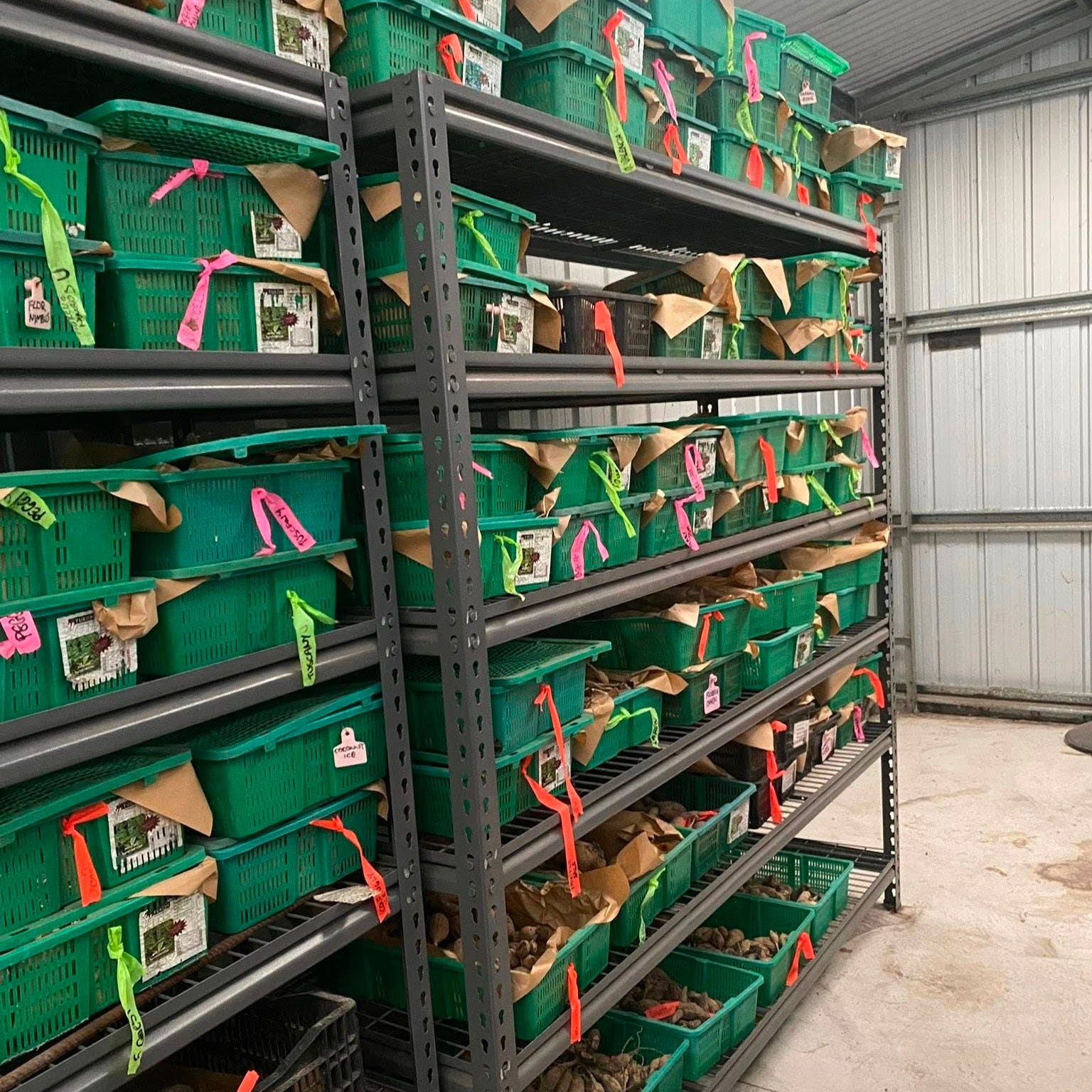
Personally, I store in an un-insulated shed that typically stays cold and damp through winter. Not amazing as a location to divide (thank you heated blankets), but it is excellent for tuber storage. What it means is that the medium I choose can’t hold too much moisture, and I’m not afraid of air flow - in fact I usually add more in the form of a pedestal fan. My setup of plastic vegetable crates, lined with paper, and medium of 50/50 coco-coir and rice hulls works perfectly.
If you store in a home that is heated to 24 degrees, for example, you might find you have more difficulties with stuff growing, mould, or other issues. If this is your only options, I’d recommend a cupboard where the temperature fluctuates less, or something like a styrofoam box that will help regulate the internal temperature better.
Storage Medium
The point of the storage medium is to create a buffer between the surface of the tuber and the conditions in the storage room. Some can wick moisture, some can hold it.
There are so many different mediums and I’ve tried a whole bunch.
Vermiculite (sterile, can easily add moisture, can be pricey, can be drying)
Paper (cheap, hard to add moisture, dust free, can draw moisture. I’ve done a pass the parcel before and it was great, each layer stopping spread of issues to the other tubers and a fun present in Spring. Not practical with lots of clumps)
Coco Coir (popular, cheap, sterile, can be added to the garden later, holds moisture well, can add moisture as needed)
Rice Hulls (cheap but not as readily available at garden centres - try agricultural supply stores that sell hay, pet food, etc - low dust/mess, can be a bit dry, holds some moisture but not as well as some other options, similar but easier than straw)
Potting Mix (readily available, relatively cheap and can be used in other garden projects, “sterile” in a horticultural sense but not in layman understanding, more prone to growing fungus and mould than some other options)
Sawdust (can be very drying & very dusty/messy but also often cheap or free. Typical advice is to get fresh each year as sap helps prevent sawdust pulling moisture from tubers)
Wood shavings (readily available from pet stores, etc., relatively clean, can add moisture to them)
I liked when I did a blend of vermiculite/coco coir/ rice hulls. Then I wondered if I needed the Vermiculite and removed it. No problems for me, but a cheaper mix so A+. I find Coco Coir can hold a bit too much moisture, hence the Rice Hulls making it fluffy. But then some dahlia friends like Bec Scoble of Floral & Stem or Dale of Dale’s Dahlias have no issues in straight coco coir.
Which is to say, again, consider what you can find locally, easily, and cheaply, and then pick what will likely work for where you are and what you need.
Storage Container
Again - pick what will help you get to your goals.
If you store outside where vermin are a problem, you will need something more secure than someone storing in a shed with a full time cat patrol (me). Someone storing in a shed might be able to live with something messier than someone storing in a cupboard.
It’s all relative.
Do the tubers need airflow? Unclear. Some people have no issue storing in sealed plastic totes. Some lose their tubers to rot. The ‘dryness’ and ‘curedness’ of your tubers may make a difference, as will temperature control. Higher temperatures make rot more likely.
Popular options include:
Plastic Vegetable Crates (large, stackable, airflow, no lid, typically need to be lined with something like a garbage bag or paper, can be messy)
Plastic storage totes (have a lid, stackable, no lining required, potentially poor airflow - recommend drilling holes if condensation/moisture becomes a problem)
Plastic Drawers (neat, look great, easily accessible, potentially pricy)
Styrofoam broccoli box (popular, great for insulating if temperatures fluctuate wildly, often free from greengrocers)
Cardboard (cheap and accessible but not ideal, can draw moisture, can be difficult to add moisture as needed, but can work in a pinch - consider lining with a garbage bag)
I use plastic vegetable crates. They were cheap, plentiful, and do double duty for me in bringing in clumps from the field and then holding the divided tubers.
Tip: if you only have a few tubers of each, you can separate them by cultivar in something like labelled organza bags and then store together in the one container if space is at a premium. Or consider something like the sock drawer organiser tubs from Kmart. There are lots of options that will suit small growers to bigger growers.
How to Arrange: the Lasagne Method
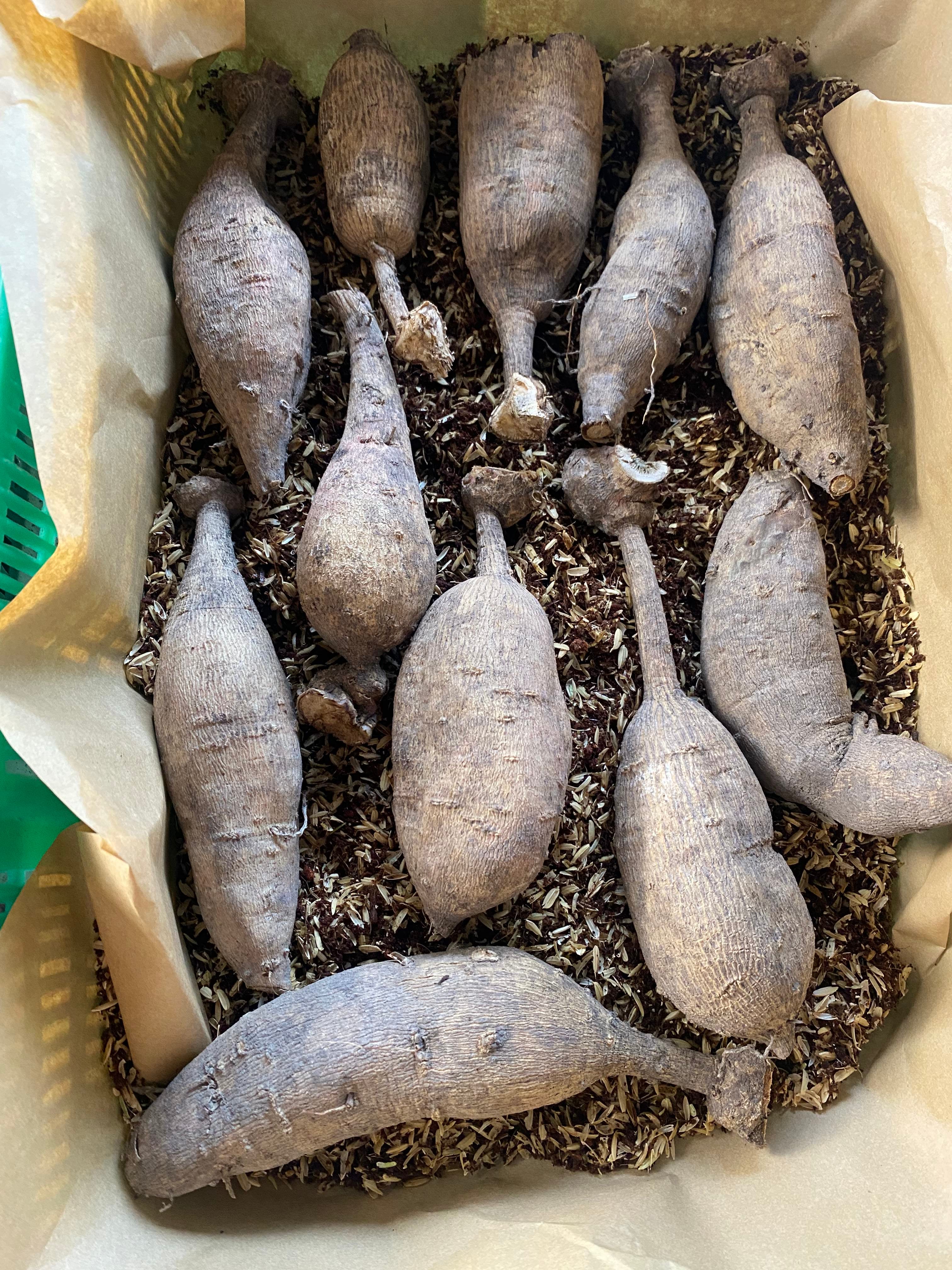
Because rot can be caused by bacteria, and spread from tuber to tuber, we want to avoid our tubers touching in storage if possible. This is achieved by laying them in the medium in a single layer so they don’t touch, covering with your storage medium of choice, and then doing another layer. Repeat until you run our of tubers or your container is full.
What About Plastic?
Look - I don’t store in soft or single use plastics (any garbage bags I use are home compostable and typically break down in the box before planting time), but I know a lot of people do. The cling-wrap method, or zip-lock sandwich bags are both somewhat popular. The Cling Wrap method works a bit like a pass the parcel, and kind of demonstrates that tubers don’t necessarily need air flow. Proper drying of tubers and temperature control are important for these. If you spot condensation you will need to change what you’re doing. Personally, I hate the idea of the plastic waste and would ask you to consider other options, but I also know sometimes you gotta do what you gotta do.
What About Mould?
Tubers may become mouldy from time to time. Sometimes it can be a sign of rot or tubers being stored too wet and warm, but sometimes it is superficial and not anything to worry about. Remove the mould and, if still firm and not rotten, dust with sulphur or cinnamon before returning to storage.
If you find rot cut it out until you only have healthy tissue and dust as above. See in the top of the picture above? That tuber was spiked through with a fork, but it’s still viable. Cut the rot out of the tuber from the tail end until it is gone - it won’t harm viability if the rot isn’t in the neck or crown. You might also consider a 10% bleach bath to remove pathogens (ensuring the tuber dries after). I’d recommend replacing storage medium if you find rot.
Some Common Problems
Too warm and dry = early sprouting and/or shrivelling tubers
Too cold and wet = rot or freezing damage
Too warm and wet = mould, rot, early sprouting and root growth (can cause issues if they wake up, grow, then don’t have enough moisture to support the growth and die)
Soft tubers = not grown for long enough or not under good conditions, not cured properly, cultivar fault, high nitrogen or low phosphorous
The Biggest Tip
The best thing is to check on your tubers every other week and adjust depending on what they need. Most problems can be fixed if you catch them early. Always remove rotten tubers to avoid spread.
Any tips or tricks? Any nightmare experiences? Any problems you want troubleshooted?
Great article Bec, where do you get Rice Hulls?